Media Contacts:
Zach Postone (212) 924-7000 x 12 | zpostone@vanalen.org
Chris Herting (504) 529-5109 | cherting@e-bmf.com
Anna Koehl (504) 524-3342 | akoehl@e-bmf.com
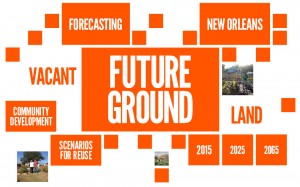
NEW ORLEANS, August 7, 2014—Van Alen Institute today announced the international competition Future Ground, and is now accepting submissions from professionals in landscape design, architecture, planning, public policy, and other related fields to develop innovative strategies for vacant land reuse in New Orleans. The competition is supported by the New Orleans Redevelopment Authority (NORA), which owns over 2,000 vacant lots and has become a regional and national leader in reuse of vacant lots for community resilience and development.
Approximately 30,000 empty lots and abandoned structures dot the landscape of New Orleans today, many of them a legacy of Hurricane Katrina. As the City nears the 10-year anniversary of the storm, Future Ground will generate flexible design and policy strategies to forecast and accommodate changes in density, demand, climate and landscape in New Orleans over the next half-century, thereby transforming these abandoned landscapes into resources for the near-term and future city.
“Future Ground offers a new approach to a persistent challenge in cities around the world. The competition will provide big-picture thinking and implementable designs for New Orleans through robust collaborations between designers and policy experts, and by developing rigorous scenarios for the future city,” said Van Alen Institute Executive Director David van der Leer. “We’re proud that the latest project in our 120-year history of organizing design competitions will help catalyze change, and continues our tradition of producing innovative solutions to complex problems.”
“New Orleans has become a leading city in the creative reuse of vacant land. We have activated over a thousand properties for urban agriculture, gardens, expansion of resident’s lots, and stormwater management—but with thousands of vacant lots remaining citywide, a significant opportunity still remains,” said NORA Executive Director Jeff Hebert. “This initiative will help us scale these efforts and create precedents for other cities to creatively and sustainably reuse vacant lands.”
Teams will be selected from an international open Request for Qualifications process. Applications are due by September 29, 2014, and will be evaluated by a jury of national leaders in design and policy.
Each winning team will receive a $15,000 stipend, and will work closely in a six-month collaborative process with local stakeholders and national leaders to bring small, incremental projects to the neighborhood and citywide scale; develop policy to support promising design strategies; and make these strategies participatory and flexible enough to be sustained into the next generation. The teams will produce solutions that may be applied to sites citywide, and can also help catalyze strategies for change in other cities around the world. Van Alen Institute will work closely with the selected teams to leverage this modest stipend to promote their work nationally and internationally and develop networks among the competitions Advisory Committee.
An Advisory Committee of local and national leaders in vacant land issues will guide the teams. In addition, teams will work closely with the Futures Team – a group of experts in landscape architecture, demographics, geography, climate change, and real estate from leading academic institutions in the region – to forecast scenarios for New Orleans in 2015, 2025, and 2065. Teams will incorporate these forecasts into their proposals that will include design, policy, financial, engineering, and other strategies.
Future Ground is the first of several competitions to be launched as an integral part of Van Alen Institute’s Elsewhere: Escape and the Urban Landscape, a multi-year initiative exploring how both the form and organization of the built environment influence our need for escape. Through competitions, public programs, and research, this unique multidisciplinary effort is bringing together innovators in design, public health, policy, and the sciences to change the way we understand cities.
Please visit past.vanalen.org/futureground for a complete RFQ, including details on the submission process. You may also contact Zach Postone at 212-924-7000 x 12.
JURY Nicole Barnes | Jericho Road Episcopal Housing Initiative, New Orleans Maurice Cox | Tulane City Center, Tulane School of Architecture, New Orleans Renia Ehrenfeucht | University of New Orleans, New Orleans William A. Gilchrist | City of New Orleans, New Orleans Jeff Hebert | New Orleans Redevelopment Authority, New Orleans Arthur Johnson | Lower Ninth Ward Center for Sustainable Engagement & Development, New Orleans Dan Kinkead | Detroit Future City, Detroit David van der Leer | Van Alen Institute, New York Elizabeth Mossop | Louisiana State University, Baton Rouge Terry Schwarz | Cleveland Urban Design Collaborative, Cleveland David Waggonner | Waggonner & Ball Architects, New Orleans
FUTURES TEAM Richard Campanella | Tulane University, New Orleans Renia Ehrenfeucht & Marla Nelson | University of New Orleans, New Orleans Elizabeth Mossop & Wes Michaels | Louisiana State University, Baton Rouge Allison Plyer | The Data Center, New Orleans
ADVISORY COMMITTEE Robin Barnes | Greater New Orleans Inc., New Orleans Sonja Beeck | University of Kassel, Berlin Adrian Benepe | Trust for Public Land, New York Toni Griffin | J. Max Bond Center, Bernard and Anne Spitzer School of Architecture, City College of New York, New York Laurie Johnson | Laurie Johnson Consulting, San Francisco Maggie Hansen | Tulane City Center, Tulane School of Architecture, New Orleans Angela Lawson | State of Louisiana Comprehensive Resiliency Program, New Orleans Alan Mallach | Brookings Institute, Washington, D.C. Michael Marrella | Waterfront and Open Space Planning, New York City Department of City Planning, New York Tom Murphy | Urban Land Institute, Washington, D.C. Emily Rauh Pulitzer | Pulitzer Arts Foundation, St. Louis Robert Rivers | City Planning Commission, New Orleans Brent Ryan | Massachusetts Institute of Technology, Cambridge Tamar Shapiro | Center for Community Progress, Washington, D.C. Mitchell J. Silver | New York City Department of Parks & Recreation, New York Stephen Zacks | Amplifier Inc. & Flint Public Art Project, Flint
###
About Van Alen Institute
At Van Alen Institute, we believe design can transform cities, landscapes, and regions to improve people’s lives. We collaborate with communities, scholars, policymakers, and professionals on local and global initiatives that rigorously investigate the most pressing social, cultural, and ecological challenges of tomorrow. Building on more than a century of experience, we develop cross-disciplinary research, provocative public programs, and inventive design competitions.
Since 1894, we have created and managed public design competitions in New York City and across the country, producing solutions to critical social, economic, and environmental issues – including vacant and underutilized land. In 1996 our competition Public Property was the first initiative to re-imagine the grounds of the decommissioned military base on Governor’s Island as a public space. In 2006 Van Alen Institute and City Parks Association of Philadelphia invited participants from around the world to propose compelling ideas for Philadelphia’s vacant land in Urban Voids, Grounds for Change.
Website: past.vanalen.org Facebook: /vanaleninstitute Twitter: @van_alen Instagram: @van_alen
About the New Orleans Redevelopment Authority The New Orleans Redevelopment Authority is a catalyst for the revitalization of the city, partnering in strategic developments that celebrate the city’s neighborhoods and honor its traditions. NORA has become a regional and national leader in reuse of vacant lots for community resilience and development. NORA promotes projects that enhance neighborhoods by making fresh produce available, providing community green space, reducing flood risk, and providing a healthy, stabilizing environment for neighborhoods too long neglected or marginalized. These programs include green infrastructure projects that use vegetation and natural processes to slow, store, and drain water after heavy rainfalls; low-maintenance landscape strategies that are economically and ecologically sustainable; and opportunities for residents to lease NORA properties for urban gardening and agriculture.
Website: www.noraworks.org Facebook: /NORA.RENEW Twitter: @NORArevitalizes Flipboard: bit.ly/1kHj6c5
