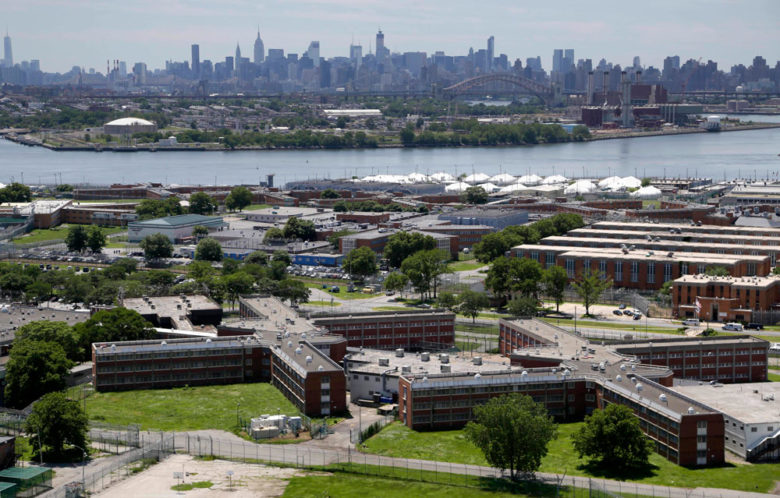
Selected project team developing design ideas for a healthier and more effective New York City jail system; announces community workshops to solicit public input.
Media Contacts:
Anna Durrett, Independent Commission | 415.203.1455
Steven Thomson, Van Alen Institute | 212.924.7000 x 12
NEW YORK, January 30, 2017 – New York City Council Speaker Melissa Mark-Viverito, the Independent Commission on New York City Criminal Justice and Incarceration Reform, and Van Alen Institute announced the launch of the Justice in Design initiative. A project team of architects, environmental psychologists, and incarceration experts will explore the future of jails in New York City and examine how to design a modern jail, with a focus on interior and exterior design elements that facilitate neighborhood integration and safer, more humane facilities. The team will research how jails impact the health and well-being of both the people inside them and the communities in which they sit.
The commission, which was convened in February 2016 at the request of New York City Council Speaker Melissa Mark-Viverito to craft a blueprint for the future of criminal justice in the city, is completing its final report and will use the work of Justice in Design to inform design principles for jail facilities. These guidelines aim to lead to policy changes toward new and healthier models of justice in New York City.
As part of the research, the project team will facilitate three community design workshops that will provide the public with an opportunity to have collaborative interaction with an inter-disciplinary team of designers, social psychologists, incarceration experts, and urbanists. These workshops, to be held in the Bronx, Queens, and Brooklyn, complement the Independent Commission’s wider community engagement efforts.
The Justice in Design project team will consist of NADAAA, an award-winning architectural and design firm based in New York City and Boston; Susan Gottesfeld of the Osborne Association; Karen Kubey, an urbanist specializing in housing and health; Criminal justice scholar Jayne Mooney of John Jay College of Criminal Justice, City University of New York; and psychologist Susan Opotow of John Jay College of Criminal Justice and The Graduate Center, City University of New York. NADAAA, directed by principals Nader Tehrani, Katie Faulkner, and Dan Gallagher, has developed an array of projects in architecture and urban design ranging from affordable housing to innovative spaces of learning, with a focus on craft, construction, and digital fabrication. Together with their project partners, they represent a collaborative and multidisciplinary team with a range of experience in design, criminal justice, environmental psychology, affordable housing, and community engagement.
“The City Council is committed to long-term, systemic reforms to our criminal justice system, including examining whether the City should continue to use Rikers Island as a jail. That is why I called for the creation of this Commission,” said Speaker Melissa Mark-Viverito. “Genuine change to our city’s jail system cannot happen without the support of our communities, and these workshops are a crucial way to ensure that everyone’s voice is heard as we continue down the path of jail reform.”
“Fundamental to creating a more just system is the need for modernized jail facilities that reflect our commitment to safety and humanity for inmates and staff alike,” said Former Chief Judge and Chairman of the Independent Commission Jonathan Lippman. “These workshops will provide an opportunity for residents from communities across New York to participate in a robust discussion regarding the future of jails, and, by extension, the future of our City’s justice system.”
“This initiative is an exciting opportunity to explore how different spaces impact human behavior,” said David van der Leer, Executive Director of Van Alen Institute. “The selected team represents the potential for multidisciplinary practitioners to develop compelling ideas for addressing a pressing challenge such as our city’s jail system.”
“We’re enthusiastic for this project’s potential to support those living and working in and visiting jails. Beyond questions of form, space, and materiality, the architectural manifestations of this study may, in fact, be lodged in the bridges we may help to build between the edifice of the jail, its cultural representation, and the context in which it is situated,” said Dan Gallagher of the selected team.
The project team launched their work on January 23rd and the team will continue to develop its report through April. The closed-call initiative began in December 2016, when the Commission and Van Alen Institute – which has organized design competitions for more than 120 years – invited eleven multidisciplinary teams to submit proposals. The project team was then selected by a jury including:
Courtney Bryan, Director of Criminal Justice Operations, Center for Court Innovation; David Chapin, Architect, Professor, Ph.D. Program of Environmental Psychology, CUNY Graduate Center; Mylan Denerstein, Partner, Gibson, Dunn & Crutcher; Alta Indelman, Principal, Alta Indelman Architect; Michael Jacobson, Executive Director, CUNY Institute for State & Local Governance; Jessica Lax, Associate Director of Competitions, Van Alen Institute; and Stanley Richards, Senior Vice President, The Fortune Society.
Justice in Design is part of Van Alen Institute’s broader inquiry into how behavior is shaped by the built environment, also explored in such initiatives as How Does the Brain Respond to the City?, an EEG workshop in Brooklyn’s DUMBO neighborhood presented with Columbia University Graduate School of Architecture, Planning & Preservation’s Cloud Lab; Ecologies of Addiction, a data-collecting research initiative exploring how the built environment impacts addiction in London, organized with Imperial College London’s Sustainable Society Network; and Shore to Core, a design and research competition that includes developing a framework to identify, measure, and analyze relationships between the design of the built environment and individuals’ wellbeing in downtown West Palm Beach, Florida and beyond.
Visit the project website for more information about Justice in Design and the community workshops.
To view a digital press kit, including high-resolution imagery, click here.
About the Independent Commission on New York City Criminal Justice and Incarceration Reform
The Commission is comprised of two dozen experts, policymakers, and advocates from a variety of backgrounds, including law enforcement, academia, judges, advocacy groups, business, and those who have spent time behind bars. The Commission was convened at the request of New York City Council Speaker Melissa Mark-Viverito, who called for its creation in February 2016 in her State of the City address. A wholly independent body, the Commission’s mission is to create a blueprint for the future of criminal justice in New York City, in particular seeking to answer three big questions: Is it possible to further reduce the population on Rikers Island? What should the jails of tomorrow look like? What should happen to Rikers Island?
About Van Alen Institute
At Van Alen Institute, we believe design can transform cities, landscapes, and regions to improve people’s lives. We collaborate with communities, scholars, policymakers, and professionals on local and global initiatives that rigorously investigate the most pressing social, cultural, and ecological challenges of tomorrow. Building on more than a century of experience, we develop cross-disciplinary research, provocative public programs, and inventive design competitions. Our work is organized into two tracks: how people are impacted by our environments, and in turn, how people impact the environment.